
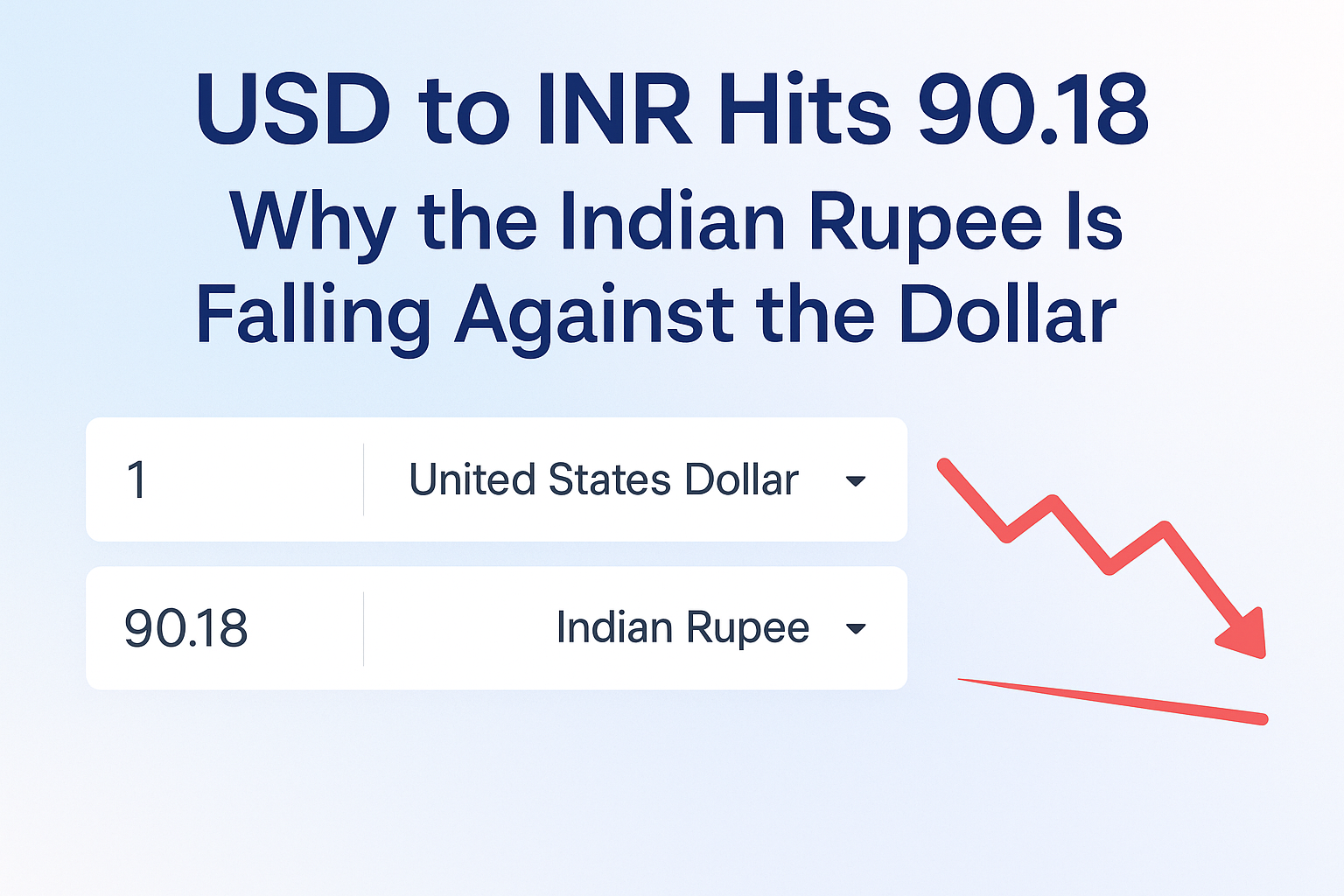
USD to INR Hits 90.18: Why the Indian Rupee Is Falling Against the Dollar in 2025
If you’ve checked the exchange rate recently, you’re not alone in being surprised. The Indian Rupee (INR) has weakened to 90.18 per US Dollar, pushing many people to search for:
“Why is the rupee falling?”
“Why is USD so high today?”
“INR price hike news”
“Dollar rate today India”
The shift has raised questions and concerns across India — from travelers and students to investors and everyday consumers. So let’s break this down clearly, simply, and accurately so you know exactly what’s going on and what this big move means for you.
USD to INR Today: 1 USD = ₹90.18
As of the latest update, $1 equals ₹90.18, marking one of the highest exchange rates in recent months. The chart over the last 5 days shows:
A rise from around ₹89.5
Gradual upward movements
A peak around ₹90.4
A closing level of ₹90.18
This isn’t a random spike — it’s a trend forming due to large-scale global and local factors.
Why Is the Indian Rupee Falling? – The 7 Major Reasons
Let’s break down the real reasons behind the rupee's weakness. These are the forces pushing USD upward and pulling INR downward:
The US Dollar Is Strong Globally
The US economy is performing better than many others right now.
When this happens:
Investors prefer holding dollars
Global money flows into US markets
Other currencies fall in comparison
This directly makes USD stronger and INR weaker.
High Crude Oil Prices Are Hurting India
India imports 85% of its crude oil.
When global oil prices rise:
India must spend more dollars
Demand for USD increases
INR weakens
High oil is one of the biggest reasons behind long-term rupee pressure.
Foreign Investors Are Pulling Out Money (FPI Outflow)
Foreign investors (FIIs/FPI) play a huge role in India’s stock markets.
When they withdraw money:
They sell Indian assets
Convert INR into USD
Demand for dollars increases
This downward pressure pushes INR lower.
Global Uncertainty Is Driving Money Into the Dollar
Whenever the world faces uncertainty—wars, elections, inflation, recessions—investors run toward the US Dollar, considered the safest currency.
This “flight to safety” makes USD stronger even if nothing is wrong with India.
Interest Rate Differences Between US and India
If US interest rates go up or stay high and India’s don’t:
Investors choose US markets
More money moves out of India
INR becomes weaker
This factor has played a huge role in 2024–2025.
Weakening Asian Currencies
Currencies like Japanese Yen, Chinese Yuan, and Korean Won have also weakened recently.
When Asian currencies fall:
Rupee gets indirectly affected
Sentiment becomes negative
Investors avoid emerging markets
Rupee often follows regional trends.
India’s Trade Deficit
India imports more than it exports.
A large trade deficit means:
More dollars leaving the country
Fewer dollars coming in
Rupee loses value
This long-term pressure plays a role in gradual INR weakening.
What the 5-Day Chart Really Tells Us
From ₹89.5 to ₹90.18 in just a few days may look small, but for currency markets, this is significant.
The trend suggests:
A steady upward climb in USD
Strong global demand for the dollar
Consistent pressure on INR
No signs of immediate reversal
Unless a major positive event occurs for India, the rupee may stay near this range.
How Does a Falling Rupee Affect You? (Simple Breakdown)
A strong dollar doesn’t impact just forex traders — it affects everyone.
Here’s how:
Imported Goods Become More Expensive
Electronics, laptops, smartphones — all become costlier because India buys them in dollars.
Fuel Prices May Increase
India buys crude oil in USD.
Higher dollar = Higher fuel cost = Possible fuel price hike.
Even if the government doesn't increase prices immediately, the pressure remains.
Studying Abroad Becomes More Expensive
If you pay tuition in USD:
₹90.18 per dollar means more rupees needed
Education loans may feel heavier
Living costs abroad rise
Foreign Travel Costs Increase
Flights, hotels, shopping → everything becomes more expensive.
A ₹1 difference in dollar rate = thousands more in total spend.
Good News for NRIs Sending Money Home
If someone sends $1,000 to India:
Before → ₹89,500
Now → ₹90,180
Great time for remittances!
Stock Market May Turn Volatile
A weak rupee often leads to:
FPI selling
Volatility
Weakness in IT, banking, and oil-sensitive sectors
Investors must watch closely.
What Is RBI Doing About the Rupee Fall?
The Reserve Bank of India usually steps in to:
Reduce volatility
Balance sudden movements
Manage forex reserves
The RBI may not stop the rupee from weakening long-term, but it prevents sharp crashes, ensuring stability.
Will the Rupee Fall Further? Expert Predictions
Experts generally believe:
INR may stay in the 89.80 – 90.50 zone
Pressure will remain as long as the dollar is strong
A recovery may come only if oil prices drop, US rates fall, or India sees strong FPI inflows
Unless a major global shift happens, INR may remain weak but stable.
Actionable Advice: What YOU Should Do Depending on Your Situation
✔ If You’re Studying Abroad
Convert part of your fees early to avoid further rate hikes.
✔ If You’re Traveling Soon
Lock in forex rates gradually instead of waiting till the end.
✔ If You’re an Investor
Expect short-term volatility but long-term stability.
✔ If You Receive Money from Abroad
This is the best time — higher USD = more INR.
FAQs (High SEO Value)
1. Why is the INR falling against the USD?
Because of high oil prices, strong US dollar, FPI outflow, and global uncertainty.
2. Will the rupee recover soon?
Not immediately — recovery depends on global economic changes.
3. Is a weak rupee bad for India?
Both yes and no.
Bad for imports, good for exports and remittances.
4. Is now a good time to buy dollars?
If you need them soon, yes — prices may rise more.
5. What was the highest USD to INR rate ever?
This ₹90+ range is among the highest historically.
Final Conclusion: INR vs USD — A Price Hike That Reflects Global Pressure
The rise of the US dollar to ₹90.18 INR is not a sudden shock — it is the result of months of global and domestic economic pressures. While it brings challenges like inflation and higher cost of living, it also benefits families receiving money from abroad.
The rupee’s future depends largely on:
Global economy
Crude oil prices
US interest rates
FPI inflow/outflow
For now, INR remains under pressure — and watching it closely is more important than ever.